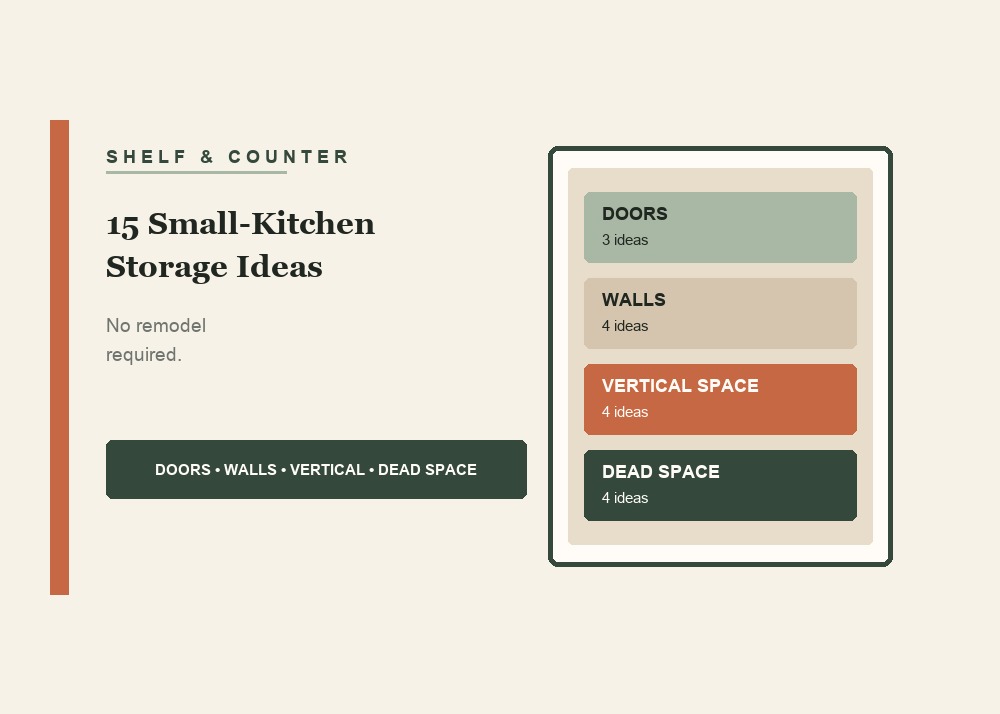
Much of a small kitchen’s unused capacity hides in plain sight: inside empty cabinet doors, on bare walls above counters, and in vertical gaps between shelves.
This guide covers fifteen practical ways to add real storage capacity without a renovation, organized by where that storage actually lives: doors, walls, vertical space, and other frequently overlooked areas. Paired with the workflow-zone approach in the companion guide, this is about expanding capacity once the existing space is already organized around how you cook.
As an Amazon Associate, we earn from qualifying purchases. Some links on this page are affiliate links.
Door interiors
1. Over-the-cabinet-door racks
Hang a slim rack on the inside of a cabinet door for lids, cutting boards, or foil and wrap boxes. Measure the door’s clearance against the cabinet’s contents before adding one, since a rack that is too deep will collide with shelves inside.
2. Pantry-door pocket organizers
A pocket-style organizer on a pantry door can hold spice packets, snack bags, or small condiment bottles. Confirm the door swings clear of nearby shelving with the organizer attached and loaded.
3. Under-sink cabinet door storage
The inside of the under-sink cabinet door may have unused clearance for a small caddy or hanging organizer, provided it does not interfere with pipes or a trash pullout already installed there.
Wall space
4. Wall-mounted rail systems
A rail with S-hooks near the stove can hold frequently used utensils, keeping them out of a drawer and within reach during cooking. Best positioned away from direct flame or heavy steam exposure.
5. Magnetic knife strips
A wall-mounted magnetic strip frees drawer space and keeps knives visible and accessible. Choose a wall location away from high-traffic areas where reaching past it is required.
The Ninonly 12-Inch Magnetic Knife Strip offers screw and adhesive mounting options. Use only the manufacturer-approved method suitable for the wall material and loaded weight; do not assume an adhesive installation is secure enough for knives. At 12″ it holds a modest number of knives—larger collections may need a longer strip.
6. Wall-mounted shelving above counters
Open shelving above a counter section can hold everyday dishware or cookbooks, provided the wall can support the mounted weight and the shelf does not crowd a work surface below it.
7. Pegboard storage panels
A pegboard section can hold pots, pans, or tools on adjustable hooks, offering flexibility to rearrange as your kitchen’s needs change. Requires secure wall mounting appropriate to the panel’s weight when loaded.
Vertical space
8. Stackable shelf risers inside cabinets
A shelf riser adds a second usable level inside a cabinet that would otherwise have one tall, half-empty space. Useful for stacking plates or bowls by size without one stack burying another.
9. Under-shelf baskets
A basket that hangs from the underside of an existing shelf claims otherwise wasted vertical clearance—useful for lightweight items like paper towels or dish towels.
10. Tension-rod dividers
A tension rod installed vertically inside a cabinet can create a narrow slot for baking sheets, cutting boards, or trays that would otherwise stack awkwardly.
11. Over-the-refrigerator storage
The space above the refrigerator, if accessible safely, can hold infrequently used items like large serving platters or seasonal cookware—provided reaching it does not require an unstable stepping surface.
Overlooked dead space
12. Toe-kick drawers
The gap beneath lower cabinets, often unused, can sometimes accommodate a shallow slide-out drawer for flat items like baking sheets or trays. This requires more installation effort than most ideas here, so weigh the payoff against the work involved.
13. End-of-cabinet vertical storage
A narrow gap at the end of a cabinet run can sometimes fit a slim pull-out rack for cutting boards, baking sheets, or trays that do not stack well elsewhere.
14. Rolling carts for flexible extra storage
A slim rolling cart can provide movable storage and a temporary landing surface, tucked into a gap when not in use and rolled out when needed. Use it for food preparation only if its surface and stability are designed for that purpose.
15. Corner cabinet turntables or pull-out systems
Corner cabinets are notorious for burying items in an unreachable back section. A turntable or a pull-out corner system can make that space usable rather than a place where items simply disappear.
The Copco 18 Inch Lazy Susan Turntable—sized larger than a small-pantry turntable to match a full corner cabinet—is a freestanding option; it needs real floor space in the cabinet for a complete rotation.
How to choose which ideas to use
Not every option belongs in every kitchen. Before adding any of these:
- Measure first. Confirm the target space’s actual clearance, not an estimate.
- Match the tool to a specific problem. A rack solves nothing if there is no category of items that actually needs it.
- Consider weight and mounting requirements. Wall- and door-mounted options need a surface that can support the loaded weight safely.
- Prioritize daily-use categories for the most convenient additions. Reserve harder-to-reach new storage, like over-the-refrigerator space, for infrequently used items.
- Add gradually. Test one or two additions before committing to a full overhaul of every dead space in the kitchen.
Common small-kitchen storage mistakes
Adding storage before organizing the existing workflow
New storage compounds a workflow problem instead of fixing it if items are not already assigned to logical zones. Address workflow first, then add storage for genuine remaining gaps.
Overloading wall- or door-mounted storage
A rack or organizer has a real weight limit. Overloading it risks damage to the mounting surface or the door hinges.
Adding storage without a specific category in mind
An empty over-the-cabinet rack tends to become a catch-all for whatever does not have another home, rather than solving a real need.
Prioritizing hard-to-reach storage for daily items
Save the most inconvenient new spaces—like above the refrigerator—for infrequently used items, not everyday essentials.
Treating every idea here as necessary
Fifteen ideas does not mean every kitchen needs all fifteen. Choose the ones that solve an actual, identified problem in your space.
Frequently asked questions
Do I need to drill into walls or cabinets for any of these?
Some do (wall-mounted rails, pegboards, magnetic strips), while others do not (rolling carts, shelf risers, tension-rod dividers). Choose based on your comfort with mounting hardware and whether your walls or cabinet materials can support it.
Which of these ideas works best for a rental kitchen?
Non-permanent options—tension rods, rolling carts, shelf risers, and some door-mounted pocket organizers—can require no drilling and move with you. Verify fit, load, and lease restrictions before installation.
How do I know if my wall can support a mounted rack or shelf?
Follow the manufacturer’s mounting instructions, use hardware rated for the wall material and loaded weight, and consult a qualified installer when the support is uncertain.
Should I add all fifteen of these ideas to my kitchen?
No. Choose only the ones that solve a specific storage gap you have already identified. Adding storage without a clear purpose tends to create new clutter rather than solving the original problem.
How is this different from the five-zone workflow guide?
The workflow guide focuses on organizing and placing what you already have. This guide focuses on adding genuinely new storage capacity using wall, door, and vertical space you are not yet using. They work best together, in that order.
More storage than it first appears
A small kitchen frequently has more usable space than its layout initially suggests—inside cabinet doors, on bare walls, in vertical gaps, and in corners that go unused. Choosing a few targeted additions, matched to specific problems and measured carefully, adds real capacity without a renovation.
Start with workflow, then add storage only where a genuine gap remains.

