Open almost any cabinet dedicated to food-storage containers and the same scene appears: a stack that looked stable until one piece is pulled from the bottom, followed by a soft plastic landslide. Quantity is not always the problem. Containers organized only as “container-shaped objects” make every retrieval harder than it needs to be.
A workable system does not require matching sets or a single container shape for every food. It requires sorting by how the containers are actually used, storing lids so they stay findable, and keeping only what earns cabinet space. This guide covers all three, plus the layout choices that make a meal-prep habit easier to maintain instead of another chore competing for counter space.
As an Amazon Associate, we earn from qualifying purchases. Some links on this page are affiliate links.
Looking for a lid organizer?
If loose lids are your main frustration, a divided organizer can keep them upright and grouped by size while matching containers nest beside them.
An option to consider: the EVERIE Expandable Food Container Lid Organizer.
Before buying: Measure your cabinet’s usable width, depth, and height, including the space your tallest lid needs. Check the organizer’s current dimensions and adjustment range on the product listing.
View the EVERIE lid organizer on Amazon
Only have a few lids? A small bin you already own may be enough. The guide below explains how to sort your containers and choose a workable layout.
The short version
- Pull every container and lid out and match them into working pairs.
- Discard warped, stained, cracked, or permanently lidless pieces.
- Sort survivors by shape and typical use, not by brand or purchase date.
- Nest same-shape containers to reclaim vertical space.
- Store lids upright and separated by matching size category, not in a loose pile.
- Assign the most reachable space to the containers used for actual weekly meal prep.
- Keep specialty and occasional-use containers in a lower-priority zone.
- Rebuild the habit around a workflow: wash, dry, nest, done—not “deal with it later.”
- Reassess every few months as container needs change.
The core problem is rarely storage space. It is that mismatched shapes and lost lids turn a five-minute put-away task into a frustrating search, which is exactly the moment a system quietly collapses.
Step 1: Empty the cabinet and pair everything
Clear the entire container storage area onto a counter or table. Do this in one session if possible, since a partial sort tends to become a permanent pile.
Match every container to its lid. This step reveals the real problem: orphaned lids and lidless bases that have occupied space for months.
Step 2: Be honest about what to discard
Set aside anything that should not go back into the cabinet:
- containers with no matching lid, and lids with no matching container;
- pieces that are cracked, warped, or no longer seal properly;
- containers that are deeply stained, scratched, or otherwise too worn to use as intended;
- duplicate shapes far beyond what the household could ever use in a week;
- takeout containers being repurposed as “free” storage, if they no longer close reliably.
Follow the container manufacturer’s guidance on reuse limits and microwave, dishwasher, or freezer suitability. If a container’s safe-use information is unclear or worn off, treat that as a reason to retire it rather than guess.
This step is uncomfortable for a lot of households because containers feel replaceable and low-stakes to keep “just in case.” But an orphaned lid or a lidless container occupies exactly as much cabinet space as a working set, while contributing nothing to the actual system.
Step 3: Sort survivors by shape and use—not by brand
Group the remaining working sets into broad categories based on how they function, not where they came from:
- Everyday meal-prep containers: the shapes used weekly for lunches, leftovers, or prepped ingredients.
- Bulk or family-size containers: larger pieces used for batch cooking or big-format leftovers.
- Small containers: for sauces, dressings, snacks, or portioned extras.
- Specialty shapes: compartmentalized trays, freezer-specific containers, or anything used only occasionally—such as Bentgo Prep 3-Compartment Meal-Prep Containers (10-pack), best kept in secondary storage since fixed compartments don’t fit every meal.
- Travel or on-the-go containers: insulated or leak-tested pieces meant to leave the house.
Most weekly meal prep relies on one or two everyday shapes. Give prime cabinet space to the shapes used repeatedly—not merely the ones that were purchased.
Step 4: Nest by shape to reclaim vertical space
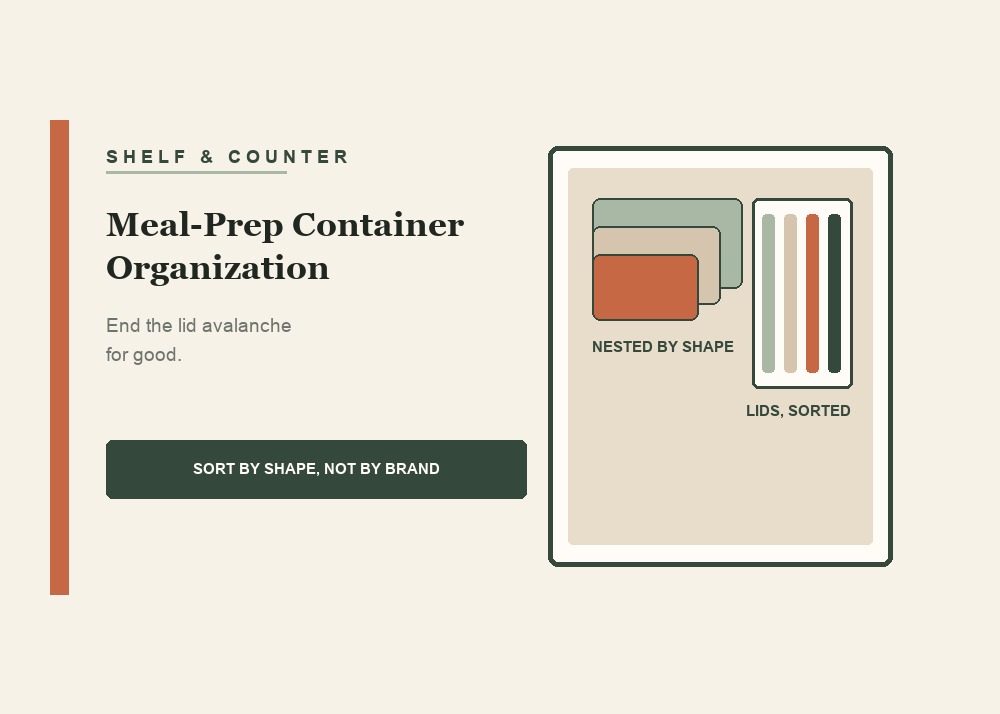
Once containers are sorted, nest same-shape, same-size pieces inside one another rather than stacking mixed shapes on top of each other. Mixed stacking causes the avalanche: a wide container topped with a narrower one has no stable resting point and slides at the slightest disturbance.
A set like the Rubbermaid Brilliance 14-Piece Food Storage Container Set comes in four graduated sizes made to nest—just keep each size nested within its own group rather than stacking across sizes, or it recreates the exact problem this step is solving.
If a cabinet shelf is tall enough, stand nested stacks upright rather than laying them flat, which uses height more efficiently and keeps each stack visible from the front instead of buried behind another stack.
For containers that do not nest well due to their shape, a shallow bin or tray can group them as a single retrievable unit rather than letting them scatter individually across the shelf.
Step 5: Give lids their own system
Lids are the actual cause of most container chaos, not the bases. A loose pile of lids in the back of a cabinet guarantees that finding the matching lid takes longer than finding the container itself.
Reasonable lid-storage approaches include:
- Vertical lid organizers: slotted racks that hold lids upright and separated, sorted by matching size category, such as the EVERIE Expandable Food Container Lid Organizer (adjustable 13.4″ to 20.5″ wide, needs a cabinet at least 12″ deep).
- A dedicated lid bin per shape family: works if the household has few enough shapes that a bin does not become its own jumbled pile.
- Lids stored with their nested containers: stacked loosely on top of the matching nested set, useful for households with only one or two dominant shapes.
Whichever method is used, the goal is the same: a lid should be identifiable and retrievable without unstacking unrelated containers first.
Step 6: Assign space by actual weekly use
Reserve the easiest-to-reach shelf or cabinet section for the everyday meal-prep category identified in Step 3. This is the shape the household reaches for multiple times a week, so it should never require moving other containers out of the way first.
Bulk containers, specialty trays, and travel containers can move to a secondary shelf, a higher or lower position, or a separate cabinet entirely if space allows. These serve a purpose, but they do not need prime cabinet space.
Step 7: Build the habit that keeps it working
An unclear put-away routine can undo a good storage layout. After washing containers:
- Dry them fully before stacking; damp containers nested together can trap moisture and odor.
- Return each container to its assigned shape category immediately rather than setting it on top of an unrelated stack “for now.”
- Match the lid back to its size category at the same time, not later.
- If a container does not have an obvious home, that is a signal to either create one or reconsider whether it belongs in the rotation.
A five-second sorting decision at put-away time is far less costly than a two-minute excavation the next time that shape is needed.
Step 8: Reassess every few months
Meal-prep habits change—new recipes, a different portioning approach, or a shift toward more or less batch cooking. Revisit the container system periodically:
- Are the “everyday” shapes from months ago still the ones actually used weekly?
- Has a specialty container quietly become a daily one, or vice versa?
- Are any shapes accumulating that no longer match how the household cooks?
Adjust which categories get prime space rather than assuming the original sort is permanent.
Common meal-prep container mistakes
Keeping every lid “in case a container turns up”
An orphaned lid without its container is clutter, not backup inventory. If the container has been missing for more than a normal wash cycle, the lid can go.
Stacking mixed shapes
This is the direct cause of the avalanche. Nest by shape and size, not by “whatever fits on top for now.”
Storing lids loose in a pile
A pile of unsorted lids turns every retrieval into a search. A slotted organizer or size-sorted bin solves this directly.
Buying a new matching set without addressing the old one
New sets add another shape family to sort rather than solving the underlying mismatch problem. Address the existing chaos before introducing a new system.
Treating every container as equally important
Not every shape deserves prime cabinet space. Reserve the best-reach shelf for what is actually used weekly.
Frequently asked questions
Why do my containers keep sliding into an avalanche?
The usual cause is mismatched shapes stacked without a stable base. Nesting same-shape, same-size containers together and storing them upright resolves most of this.
Should I get rid of containers with no matching lid?
Yes—once a normal wash cycle has passed without producing the match. An orphaned base takes up the same space as a complete set while doing none of the job.
What is the best way to store lids?
A vertical, slotted lid organizer sorted by size category works well for most households. A per-shape lid bin can also work if the household has a small number of dominant shapes.
How many meal-prep containers do I actually need?
Enough working sets of the everyday shape to cover a normal prep cycle, plus a modest reserve. More than that tends to create clutter rather than convenience.
Should I use matching sets or mixed brands?
Neither is inherently better. A consistent shape family nests and stacks more predictably, but mixed brands work fine if you sort by shape rather than brand.
Is it safe to reuse takeout containers for meal prep?
Only if the container still seals reliably and the household follows the original manufacturer’s guidance on reuse and food-contact suitability. Retire containers that no longer close well or show wear.
A container system that survives the wash cycle
A meal-prep container cabinet does not need matching sets or a single universal shape to stay usable. It needs a sort by shape and use, lids stored where they can actually be found, prime space reserved for the containers used weekly, and a five-second put-away habit that keeps the system from sliding back into a pile.
Done well, opening that cabinet should feel like reaching for a tool, not defusing a small avalanche.

